
Two numbers decide whether you can retire in Dominican Republic on a pension: US$1,500 a month, which is the income the law asks for, and roughly US$1,500 to US$2,500 a month, which is what a comfortable life in a beach town like Las Terrenas actually costs. Clear both and the paperwork is the easy part. Buying rather than renting changes the second number more than most people expect, and it changes your tax position too.
This guide is for two readers. The first is an American or Canadian weighing a move and trying to work out whether the budget survives contact with reality. The second already owns here, or is about to, and wants to know what residency adds on top. Both get the same answer in different order, so the residency rules come first and the money follows.
Quick Facts
Law 171-07 sets the pensionado threshold at US$1,500 a month of foreign pension income, US$2,000 for a rentista on investment income, and US$250 more per dependent.
The Direccion General de Migracion runs the application through its foreign investment window, and pensionado and rentista applicants go straight to residency rather than through the multi-year temporary track.
A one-bedroom apartment outside the center rents for about RD$15,200 a month and one in the center for about RD$27,900, which is roughly US$247 and US$452 at October 2026 rates.
Residency under Law 171-07 carries tax benefits for owners, including exemption from the 3% transfer tax on a first home and a 50% reduction in the annual property tax.
Social Security keeps paying in the Dominican Republic, but Medicare does not travel. Private coverage is a line item, not an option.
What It Takes to Retire in Dominican Republic
The country does not have a retirement visa in the way Portugal or Panama do. It has a residency category built for people living on money earned somewhere else, created by Law 171-07, and in practice that is the retirement route. Article 3 of the law, linked above, sets the income test at US$1,500 a month for a pensioner and US$2,000 for a rentista, with US$250 a month more for each dependent. The thresholds are written in dollars, so a weak peso does not move them.
Pensionado, Rentista and Investor
The pensionado category is for a pension paid from abroad, whether that is Social Security, a former employer, a government scheme or military retirement pay. The rentista category covers stable passive income from outside the country, which is where rental income, dividends and annuities sit, and it asks for a longer documentation trail because the income has to look durable rather than recent. The investor route exists separately for people placing capital here, and qualifying real estate can count toward it.
The application itself goes through the foreign investment window at the immigration department, which is a different queue from the ordinary temporary residency line. That is the part worth knowing: this category is not simply a faster version of the standard process, it is a separate one, and the Dominican consulate in your home country is where it starts. Expect apostilled documents, a police certificate and a medical exam, all obtained before you fly.
What Residency Adds That a Tourist Stamp Does Not
You do not need residency to buy property here. Foreigners buy in their own name with a passport, and plenty of owners run a second home for years on tourist entries. Residency is what you need to live here, to open certain bank accounts without friction, and to claim the tax treatment below. Anyone treating the Dominican Republic as a place to spend eight months a year rather than three weeks will want it.
What a Month Actually Costs in US Dollars
National averages are the place to start and not the place to stop. The line items below come from Numbeo's Dominican Republic data, converted at roughly RD$61.7 to the dollar.
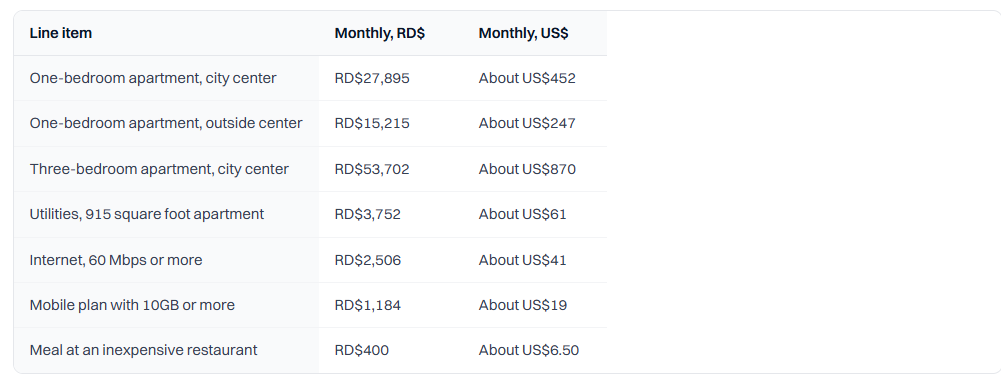
Two adjustments matter before you build a budget off that table. The first is location. Those are national numbers, and a beach town where foreigners rent is not a national number: rent in the tourist zones runs well above it, and a single person on a moderate lifestyle is usually budgeting somewhere between US$1,200 and US$1,800 a month once rent is included. The second is air conditioning. A Samana electricity bill with the AC running most of the day looks nothing like one without it, and that single habit moves a budget by more than groceries do.
The honest version for Las Terrenas is this. A couple renting a modest apartment, eating mostly local food, running one car and not air conditioning the whole house can live on about US$1,800 a month. A couple who want a sea view, eat out four nights a week, keep the AC on and fly home twice a year are closer to US$3,000. Neither figure is wrong. They describe different lives.
Why Owning Changes the Math More Than People Expect
Buying removes the largest and least predictable line in the table, which is rent, and it is the one line that moves against a retiree every year. It also changes the tax position, because the benefits attached to Law 171-07 residency are mostly property benefits. As the Pellerano and Herrera analysis linked above sets out, those include exemption from the 3% transfer tax on a first home, a 50% reduction on the annual property tax, and a 50% reduction on mortgage taxes. Residency has to be approved before you close for the transfer tax exemption to apply, which is a sequencing point worth raising with your attorney early.
The annual property tax is called IPI. It is 1% a year, charged only on the part of your combined Dominican property value above RD$10,695,494 for 2026, which is a little over US$173,000. Below that, nothing is due. The DGII also lists the 50% reduction for pensioners and rentistas living on foreign-source income, which applies on top of the exempt amount.
On the purchase side, asking prices published by Diario Libre in September 2026, drawn from Ubikala's analysis of active listings, put the Las Terrenas median near US$2,225 per square meter as of August 2026. A 75 square meter apartment at that median is about US$167,000, which sits under the IPI threshold entirely. Compare that with renting the same apartment at roughly US$700 to US$900 a month in a tourist zone and the arithmetic resolves itself inside a decade, as long as you genuinely stay. That caveat is doing real work, which is why there is a section on renting first further down.
Browse what is currently on the market in our Las Terrenas apartment listings and the same bands show up: studios and one-bedrooms under the tax threshold, two-bedrooms with a view above it.
Best Places to Retire in the Dominican Republic
Four markets carry nearly all the foreign retirement demand, and they are genuinely different places rather than four versions of the same beach.
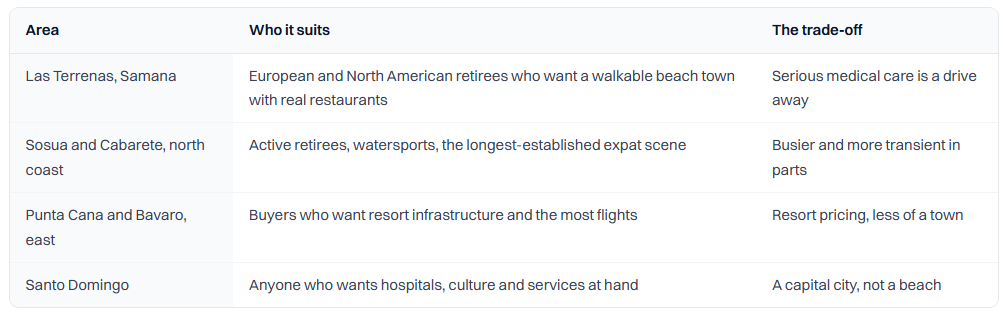
For Las Terrenas specifically, the access question decides a lot. El Catey International (AZS) sits about 30 minutes from town by road, which is the shortest airport run of any Dominican beach market, but it is a small airport with a thin schedule, and most arrivals still come through Santo Domingo roughly two and a half hours away on the Samana highway. If family will visit often, check the actual routes before you commit, not the map.
Healthcare, and the Part Americans Get Wrong
This is where plans break. As the Medicare guidance linked above states, Medicare does not cover care received outside the United States except in a few narrow situations, and Medicare drug plans do not cover prescriptions bought abroad. Moving to the Dominican Republic from America means replacing that coverage, not supplementing it. Budget for private insurance or an international policy as a fixed monthly cost from day one, and price it at your current age rather than the age you were when you first visited.
The practical picture in Las Terrenas is reasonable for ordinary life and thin for emergencies. Clinics and pharmacies in town handle routine care. Anything serious means Santo Domingo, which is where the private hospitals that meet international standards are, and that is a two and a half hour drive. Retirees managing a condition that needs a specialist every few weeks should think hard about that drive before falling for the view, or should look at the capital instead.
Social Security, Taxes and the Money Side
Social Security keeps arriving. The Dominican Republic is a country the Social Security Administration can send payments to, and the agency publishes a screening tool for anyone who wants to confirm their own case. The payments themselves stay subject to US tax rules, because American citizens file regardless of where they live.
On the Dominican side, the system is territorial: income earned here is taxed here, and foreign income is largely outside the net, with corporate and most withholding rates sitting at 27% for what is caught. Under Law 171-07 the pension or rental income you declared to qualify is exempt from Dominican income tax, which is the quiet reason this residency category exists at all. Rental income from a Dominican property is a different matter and is taxable here.
None of that is tax advice, and the interaction between Dominican residency and your home country's rules is the one piece worth paying an accountant to look at before you move money
.
How the Dominican Republic Compares With Other Caribbean Options
On cost, it is at the bottom of the region rather than the middle. Numbeo-based comparisons of Caribbean markets put a single person's non-rent monthly spending near US$480, among the lowest in the Caribbean, with the average price to buy at about US$1,668 per square meter against US$1,925 in the Bahamas.
Against the US or Europe, the gap shows up most in rent and services and least in imported goods. A car, a laptop, a bottle of European wine or an air conditioner costs more here than it does in Miami or Madrid. Rent, labor, produce, eating out and property tax cost dramatically less. Retirees who spend locally do very well. Retirees who want to reproduce a North American shopping basket find the savings thinner than the headline numbers promise.
The Case for Renting First
Here is the part that works against our own interest to say. If you have not already lived here through a full year, rent before you buy. Not for a two-week look, for six to twelve months, and ideally including September, which is the hot, wet, quiet end of the calendar when the restaurants thin out and the rain arrives in earnest.
Two reasons. The first is that Las Terrenas, Cabarete and Punta Cana suit different temperaments, and almost nobody picks correctly from a brochure. The second is practical: resale takes time in a market this size, so a purchase you change your mind about is not a decision you can reverse in a month. Renting first costs you perhaps US$8,000 to US$10,000 across a year in a tourist zone. Buying the wrong apartment costs considerably more than that, and it costs it slowly.
The buyers who should skip the renting year are the ones who already know the town, usually because they have been coming for a decade. For everyone else, the year is cheap insurance.
Frequently Asked Questions
Can Americans live in the Dominican Republic?
Yes, with no restriction on buying property and a clear residency route for retirees. Americans can own real estate in their own name without residency, and those with a foreign pension of at least US$1,500 a month can apply for pensionado residency under Law 171-07. The US Embassy estimates that around 100,000 US citizens already live in the country.
What are the actual living expenses for expats in the Dominican Republic?
Most single expats land between US$1,200 and US$1,800 a month including rent, and most couples in a beach town between US$1,800 and US$3,000. Rent outside the center averages around US$250 a month nationally and considerably more in tourist zones, utilities run about US$61 before heavy air conditioning, and internet about US$41. Owning instead of renting removes the largest line.
Is it affordable to retire in the Dominican Republic compared to other Caribbean countries?
It is one of the most affordable options in the region. Comparisons of Caribbean markets put non-rent monthly spending for a single person in the Dominican Republic near US$480, below most of the English-speaking Caribbean, and property prices per square meter below the Bahamas. The trade-off is infrastructure rather than price.
Which areas in the Dominican Republic are best for expats to live in?
Las Terrenas, Sosua and Cabarete, Punta Cana and Santo Domingo carry nearly all the foreign demand. Las Terrenas suits retirees who want a walkable beach town with a European feel, the north coast suits active retirees, Punta Cana suits buyers who want resort infrastructure and flight options, and Santo Domingo suits anyone who wants hospitals and services at hand.
What are the Dominican Republic residency requirements for retirees?
A foreign pension of at least US$1,500 a month, plus US$250 per dependent, documented and legalized. Rentista applicants need US$2,000 a month in stable passive income from abroad instead. Applications run through the foreign investment window at the immigration department, and start with a residency visa at a Dominican consulate in your home country.
How do the costs of rent and daily living in the Dominican Republic compare to the US or Europe?
Rent and services are dramatically cheaper, imported goods are not. A one-bedroom apartment in a Dominican city center averages about US$452 a month, a fraction of the equivalent in most US or Western European cities, and labor, produce and eating out follow the same pattern. Cars, electronics and imported food cost the same or more than they would at home.
The Year That Decides It
The decision to retire in Dominican Republic property rather than rent it is really two decisions, and they are best made a year apart. Qualify for residency, pick the town by living in it through a wet September, then buy the apartment you already know you want. People who do it in that order almost never regret the purchase.
Considering a Conversation
To reach Leo and the Leo Estate Group team: contact page. We work with retirees at both stages, the rental year and the purchase, and can put real numbers against a specific building before you commit to either.
Phone
+1 829 707 0999
Office
Sector La Bonita, Calle Jose Antonio Martinez, beside Mosquito Boutique Hotel, Las Terrenas 32000, Samana
Hours
Monday to Sunday, 9am to 5pm
Sources
Source
Used for
Ministerio de Hacienda, Ley No. 171-07 (full text)
Article 3 income test: US$1,500 a month for a pensioner, US$2,000 for a rentista, US$250 per dependent
Direccion General de Migracion, residence for retired or pensioned applicants
The application runs through the foreign investment window of the immigration department
Pellerano and Herrera, tax exemptions under Law 171-07
Exemption from the 3% transfer tax on a first home, 50% reduction on the annual property tax, and 50% reduction on mortgage taxes
Numbeo, cost of living in the Dominican Republic
Rent, utilities, internet, mobile and restaurant line items used in the cost table
Expat Focus, Dominican Republic cost of living
Single-person moderate monthly budget range of US$1,200 to US$1,800 including rent
DGII Help Centre, exempt amount for the Real Estate Property Tax
2026 IPI exempt amount of RD$10,695,494 for individuals
DGII, Impuesto al Patrimonio Inmobiliario
The 50% IPI reduction for pensioners and rentistas living on foreign-source income
Social Security Administration, payments outside the United States
Social Security payments continue to the Dominican Republic, with a screening tool for individual cases
Medicare, travel outside the US
Medicare generally does not cover health care received outside the United States
PwC Worldwide Tax Summaries, Dominican Republic, Other taxes
Dominican corporate and withholding rates, and the territorial basis of the tax system
Diario Libre, Las Terrenas and the new generation of luxury property tourism
August 2026 median asking price of about US$2,225 per square meter in Las Terrenas, from Ubikala data
Acento, Banco Central reference exchange rate, October 2026
Peso to dollar reference rate used for every conversion on this page
Samana El Catey International Airport
Roughly 30 minutes by road from the airport to Las Terrenas
Immigrant Invest, cost of living in the Caribbean
Non-rent monthly spending near US$480 for a single person, and average purchase price of about US$1,668 per square meter against US$1,925 in the Bahamas