
People search how much is a house in Dominican Republic and get a listings page instead of a number. Here is the number. The national median asking price for an apartment is about US$210,000, or roughly US$2,000 per square meter, and houses sell for less per square meter than apartments do, at about US$1,848. Those are national medians, and the spread behind them is wider than almost any market you will have shopped before.
That spread is the real answer. The same money buys a three-bedroom house in a Santo Domingo suburb, a one-bedroom apartment two streets from a beach in Samana, or a parking space in Cap Cana. This guide gives the national figures first, then the market-by-market numbers, then what a US$100,000 budget genuinely reaches, and finally the costs that sit on top of the sticker price.
Quick Facts
The national median apartment asking price is about US$210,000, or US$2,000 per square meter, from an analysis of 65,160 active listings with a June 2026 cutoff.
Houses ask less per square meter than apartments. Properstar's June 2026 medians were DOP 108,275 per square meter for houses against DOP 139,044 for apartments.
Prices are still rising but more slowly. Dominican house prices were up 7.74% in the year to the first quarter of 2026, and about 2.97% after inflation, down from 8.84% in 2024.
The cheapest and dearest markets differ by more than three times. Cap Cana's median is US$3,465 per square meter; Santo Domingo Norte's is US$1,029, with a median apartment price near US$90,000.
Almost nobody borrows here. Numbeo puts the 20-year fixed mortgage rate at 12.92%, which is why most foreign purchases are cash or developer payment plans.
How Much Is a House in Dominican Republic, in One Number
Take the national medians as a starting line and nothing more. The Properstar listing data behind the Global Property Guide index cited above put June 2026 median asking prices at roughly US$2,373 per square meter for apartments and US$1,848 for houses. A 120 square meter family house at the national house median works out near US$222,000, and a 90 square meter apartment near US$214,000.
Those two figures are close enough that the house-or-apartment question is rarely decided by price alone. What decides it is what you want to do with the property. An apartment in a managed building is the easier thing to leave empty for six months of the year, and the easier thing to put into short-term rental. A house with land costs about the same to buy and more to maintain, and it is the better fit for anyone actually living here full time.
Why Houses Cost Less Per Square Meter Than Apartments
This surprises buyers coming from North America, where a detached house usually carries the premium. Two things drive it here. Apartment supply is concentrated in the places people pay most to be, which is central Santo Domingo and the resort corridors, while houses are spread across the whole country including towns where almost nobody foreign is buying. And an apartment price buys shared amenities, security and a managed building, all of which land in the per-meter figure. A house buys land, and land in a secondary town is cheap.
A second data source gives a useful sanity check. Numbeo's crowd-sourced figures, linked above, put the price to buy an apartment at about RD$8,583 per square foot in a city center and RD$6,355 outside it. At the Banco Central reference rate in October 2026 that converts to roughly US$1,497 and US$1,109 per square meter. Those sit well below the listing-portal medians, and the gap is methodology rather than error: portals skew toward the newer, larger, foreign-facing stock that a Dominican family buying in a local neighborhood never appears in. If you are buying as a foreigner, the portal numbers are the ones that describe your market.
What Prices Look Like Area by Area
This is where the national figure stops helping. The table below uses median asking prices per square meter from the 65,160-listing analysis cited above, with the Las Terrenas figure from a separate Samana dataset discussed further down. Every one of these markets is inside a country you can drive across in a day, which is worth holding in mind when the top and bottom of the list differ by more than three times.
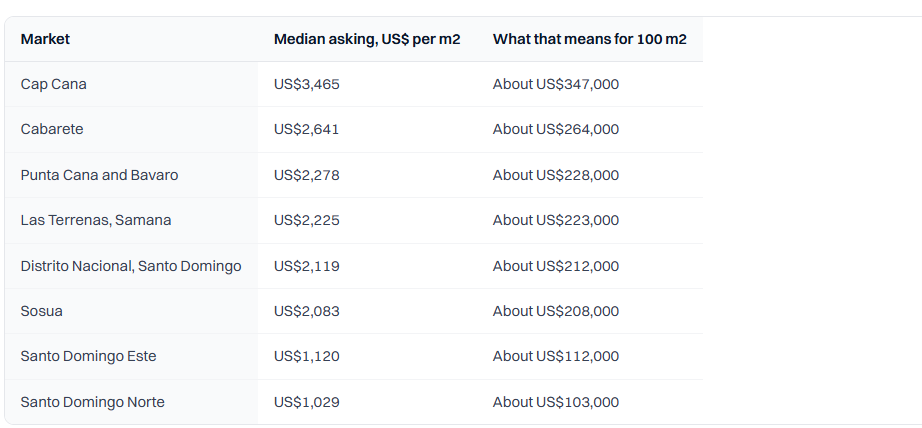
Read that table as a map of demand rather than of quality. Santo Domingo Norte is not a bad place to live. It is a place where almost no foreign buyer is competing, which is exactly why the number is low. Cap Cana is not three times better built than Sosua. It is three times more contested.
What US$100,000 Actually Buys
A house for sale in Dominican Republic under 100k is a real category, not a myth, but it is concentrated in specific places. At the Santo Domingo Norte median of about US$90,000 for an apartment, a hundred thousand dollars buys a finished family unit outright. The same budget in the outer municipalities of Greater Santo Domingo, or in secondary cities, reaches a modest house with land.
In the coastal markets the arithmetic changes shape. At Punta Cana and Bavaro prices, US$100,000 buys about 44 square meters, which is a studio or a tight one-bedroom. In Las Terrenas it buys about 45 square meters on the same math. On the national house median it reaches about 54 square meters of house, usually inland.
So the honest framing is this. Under US$100,000 you are choosing between space inland and position on the coast, and you cannot have both. Buyers who want a beach town and a real two-bedroom should plan on US$180,000 to US$250,000 rather than US$100,000, and buyers whose ceiling is genuinely a hundred thousand will do better looking at a small coastal apartment than at a large inland house they will struggle to resell.
Las Terrenas and the Samana Premium
Our own market sits just above the national median and well below the eastern resort zones. Figures published by Diario Libre in September 2026, drawn from Ubikala's analysis of active listings, put the Las Terrenas median near US$2,225 per square meter as of August 2026, with Punta Bonita around US$2,951, El Portillo around US$2,621 and Las Ballenas around US$2,350.
The sector spread inside one small town is the point. Roughly US$730 per square meter separates Punta Bonita from the town median, which on a 150 square meter villa is more than US$100,000 of difference for a twenty minute walk. If you are comparing our Las Terrenas villa listings against anything else, compare sector against sector rather than town against town, because the town average hides most of what you are paying for.
Asking Prices Are Not Sale Prices
Every number on this page, and on every competing page you will read, is an asking price. The Dominican Republic has no public register of closed sale prices, which means there is no official national house price index and no equivalent of a sold comparables report. The widely quoted indices are all built from listing portals.
Two consequences follow. Properties in slower segments transact below asking, and the gap is real money on a six-figure purchase. And whenever you see a confident claim that Dominican home prices rose or fell by a precise percentage, it is measuring what sellers hoped for, not what buyers paid. Treat the medians here as the top of a negotiating range rather than as a valuation, and have your attorney check the DGII appraisal on any specific property before you put a number in writing.
What Sits on Top of the Sticker Price
The purchase price is not the purchase cost. The buyer pays a 3% real property transfer tax at the Registry, calculated on the higher of the agreed price and the DGII appraisal, so a contract written below market does not reduce it.
Annual property tax is gentler than most buyers assume. IPI is 1% a year, charged only on the part of your combined Dominican property value above RD$10,695,494 for 2026, which is a little over US$173,000. A US$150,000 apartment owes nothing at all. A US$300,000 villa owes roughly US$1,250 a year.
New build in a tourism zone often carries CONFOTUR benefits, which waive the transfer tax at purchase and the annual IPI for up to 15 years from project completion. That is worth real money and it is a legitimate reason a certified unit can be priced slightly above an identical resale.
At the other end, an individual selling Dominican real estate now pays 10% on the gain under the June 2026 tax reform, down from a scale that reached much higher, while companies still pay 27%. Budget it into your exit, not just your entry.
What Moves the Price Inside One Market
Once you have fixed on a market, four things explain most of the variation between two apartments on the same street, and none of them is the number of bedrooms.
Distance to the water is the first and by far the largest. In a beach town the gradient is steep enough that one block can cost more than a second bathroom. The second is whether the unit is new build, resale or pre-construction. Pre-construction typically asks less per square meter than finished stock and carries delivery risk instead, and in markets with heavy new supply it has been asking more than nearby resales, which is worth checking rather than assuming. The third is the tax position, because a CONFOTUR-certified unit and an identical resale next door are not the same purchase. The fourth is the building itself: a reliable generator, a working water supply and a competent administration are the difference between a property you can rent out and one you cannot, and they do not show up in the asking price at all.
That last point is where local knowledge earns its keep. Two buildings fifty meters apart in Las Terrenas can have identical per-meter pricing and completely different reputations among the people who manage rentals here.
How to Compare Apartment Prices Between Areas
Four steps make the comparison honest, and most buyers skip at least two of them.
Work in price per square meter of built area, not total price. Total price compares two different-sized homes and tells you nothing.
Compare sectors, not towns. The Las Terrenas figures above show a 33% spread inside a single town, and Santo Domingo's spread is larger still.
Check whether the quoted area includes terraces, parking and common space. Developers vary on this and it moves the per-meter figure by double digits.
Add the carrying costs before you compare. A unit with US$400 a month in condo fees and a non-CONFOTUR tax position is not the same purchase as one without, even at the same price.
Where the Cheap Listings Are a Trap
Here is the part that works against our own interest to say. The cheapest numbers in that table are not automatically the best buys, and some of the cheapest listings in any Dominican market should be left alone.
The common problems are title and liquidity. Older rural and beachfront parcels can carry unresolved title history, boundary questions or inherited ownership that takes months to clear, and a price that looks like a bargain is sometimes pricing that risk honestly. Liquidity is the quieter one. In a market with no closed-sale register and a thin resale pool, a property that foreign buyers do not want takes a long time to sell again, whatever you paid for it.
If your budget is tight, the better trade is usually a smaller unit in a market with real demand than a larger one in a market without it. That advice costs us commission on the bigger ticket, and it is still the advice.
Frequently Asked Questions
How much are houses in the Dominican Republic?
The national median asking price works out at about US$1,848 per square meter for houses, so a 120 square meter family home sits near US$222,000. Apartments ask more per square meter, around US$2,000 nationally, with a median apartment price near US$210,000. Both figures hide a range that runs from about US$1,029 per square meter in Santo Domingo Norte to US$3,465 in Cap Cana.
Can I buy a house in the Dominican Republic for under 100k?
Yes, mainly in the outer municipalities of Greater Santo Domingo, secondary cities and inland towns. Santo Domingo Norte's median apartment price is about US$90,000. In the coastal markets where most foreign buyers look, US$100,000 buys roughly 44 to 45 square meters, which is a studio or a small one-bedroom rather than a house.
How much is an apartment in the Dominican Republic?
About US$210,000 at the national median, based on an analysis of more than 65,000 active listings with a June 2026 cutoff. Expect roughly US$2,278 per square meter in Punta Cana and Bavaro, US$2,225 in Las Terrenas, US$2,119 in central Santo Domingo and about US$1,029 in Santo Domingo Norte.
How do I compare prices for apartments in different areas of the Dominican Republic?
Convert everything to price per square meter of built area, then compare sectors rather than towns. Confirm whether the quoted area includes terraces and parking, since developers differ, and add condo fees and the property tax position before you judge two units equal. A single town can show a 30% internal spread.
Are home prices in the Dominican Republic still rising?
Yes, but more slowly. Prices rose 7.74% in the year to the first quarter of 2026, which is about 2.97% after inflation, down from an inflation-adjusted 8.84% in 2024. The slowdown is most visible in segments with heavy new supply, and least visible in small, supply-constrained coastal towns.
Do foreigners pay more for property in the Dominican Republic?
Not in law. Foreigners buy on the same terms as Dominican nationals, in their own name, with the same 3% transfer tax and the same annual property tax rules. In practice a buyer who does not know local pricing can pay above market, which is an argument for working from per-square-meter data rather than from a single asking price.
The Number Behind the Number
How much is a house in Dominican Republic terms depends almost entirely on which square kilometer you are standing in, and the national median is the least useful figure in this guide. Pick the market first, get the per-square-meter number for the specific sector, then look at listings. Done in that order, the price stops being a surprise.
Considering a Conversation
To reach Leo and the Leo Estate Group team: contact page. We can give you the current per-square-meter range for any sector of Las Terrenas and tell you where a specific asking price sits inside it before you make an offer.
Phone +1 829 707 0999
Office Sector La Bonita, Calle Jose Antonio Martinez, beside Mosquito Boutique Hotel, Las Terrenas 32000, Samana
Hours Monday to Sunday, 9am to 5pm