

Dominican Republic property tax is one percent a year, and it is charged only on the value above an exemption that sits at RD$10,695,494 for 2026, a little over US$173,000. A large share of the apartments in our Las Terrenas property listings fall under that line and owe nothing at all. A beachfront villa owes a few thousand dollars a year. The costs that actually move a deal sit somewhere else, at closing and at sale.
This guide is written for the two people who ask us about this most: a European or North American buyer weighing a second home on the Samana peninsula, and the owner who has already closed and wants to know what lands in March. It covers the annual IPI, the three percent transfer tax, the June 2026 reform that most English-language guides still have not caught up with, and the exemptions that quietly wipe the bill out for a lot of owners.
Quick Facts
IPI, the annual property tax, is 1% of the combined value of your Dominican property above RD$10,695,494 for 2026. The exempt amount is re-indexed to inflation each January.
At the Banco Central reference rate in October 2026, that threshold is worth roughly US$173,000. It belongs to the owner rather than to the property, and companies do not get it.
Buyers pay a one-time real property transfer tax of 3%, charged on the higher of the agreed price and the DGII appraisal.
Since June 2026, an individual selling Dominican real estate pays 10% on the gain. Companies still pay 27%.
IPI falls due in two equal installments, on 11 March and 11 September, with the annual declaration filed in the first 60 days of the year.
How Dominican Republic Property Tax Works
The tax is called IPI, short for Impuesto al Patrimonio Inmobiliario. It is collected nationally by the DGII, the tax office, rather than by the town hall, so the rate in Las Terrenas is identical to the rate in Santo Domingo. There is no municipal mill rate to look up and no county assessor to argue with.
Two features make it behave differently from property tax in the United States, Canada or France, and both of them catch foreign owners out.
The Exemption Belongs to You, Not to the House
DGII adds up every property you own in the country and applies the exempt amount once. Own three apartments at US$90,000 each and you do not get three exemptions, you get one, and the combined US$270,000 is assessed as a single holding. Buy through a Dominican company and the exempt amount does not apply at all: the company pays 1% from the first peso. That single line settles the personal name versus company question for a lot of second-home buyers more decisively than the liability arguments do.
The Number DGII Uses Is Not Your Purchase Price
IPI is charged on the DGII appraisal, not on the figure written into your deed. Those appraisals tend to sit below market, sometimes well below, which is why owners who run the math on their purchase price usually overestimate the bill. The relationship flips at closing, where the transfer tax is charged on whichever of the two figures is higher.
What IPI Costs on a Las Terrenas Apartment or Villa
Asking prices give a usable ceiling for the calculation. Figures published by Diario Libre in September 2026, drawn from Ubikala's analysis of active listings, put the Las Terrenas median near US$2,225 per square meter as of August 2026, with Punta Bonita around US$2,951, El Portillo around US$2,621 and Las Ballenas around US$2,350. Those are asking figures rather than closing figures.
Run three typical purchases at roughly RD$61.7 to the dollar.
The Three Percent Transfer Tax at Closing
The buyer pays the 3% real property transfer tax once, when the title moves at the Registry. It is calculated on the higher of the agreed price and the DGII appraisal, so writing a contract below market does not reduce it, and in an area that has been revalued recently it can raise it.
On the US$200,000 apartment above, that is US$6,000. On the US$575,000 villa, US$17,250. For most buyers this is far and away the largest tax line in the transaction, and it is the one worth building into the offer rather than discovering at signing.
The June 2026 reform left it untouched. The analysis published by Pellerano and Herrera, a Dominican law firm, is explicit that Law 30-26 did not amend the 3% transfer tax, so it stays a real cost unless CONFOTUR or another special regime applies.
What Law 30-26 Changed in June 2026
The biggest change for owners arrived in June 2026, and most of the English-language guides still ranking for this topic have not caught up with it. Law 30-26 set the flat 10% rate on capital gains noted above when an individual sells Dominican real estate. Companies continue to pay 27%, which is one more reason the holding structure deserves a conversation before you sign rather than after.
The Reliefs That Come With It
Presenting the law to business owners in Santiago, the director of the DGII set out the main reliefs attached to the new rate: an exemption for the habitual residence, the option to reinvest the proceeds in another habitual residence within six months, and an exemption for sellers over 65. The same presentation confirmed that the tax on mortgage operations falls to 1% in 2027 and disappears from 2028.
One Piece Is Still Missing
The law set the rate without settling the method. The implementing regulation has not yet defined how the taxable base is worked out, including whether the inflation adjustment in article 289 of the Tax Code carries across to the new 10% regime. Until that lands, a seller's exposure is a range rather than a figure. If you are buying from an individual owner, that uncertainty belongs in the price negotiation, because it is sitting on their side of the table.
Who Pays Less, and Who Pays Nothing
Four groups get relief, and the DGII lists them plainly.
Owners whose combined Dominican property sits at or below the exempt amount pay nothing.
A home owned by someone aged 65 or over is excluded, provided it is their only real estate in the country.
Pensioners and rentistas living on foreign-source income pay half, under the Law 171-07 incentive regime.
Rural land, and agricultural improvements built on rural land, sit outside the tax altogether.
The over-65 rule is narrower than it sounds, because a second property anywhere in the country breaks it. It also catches people in the pleasant direction. Retired owners who had budgeted for an annual bill have turned up at a DGII counter and been told their single home puts them outside the tax entirely. It is worth checking before you set money aside for it.
CONFOTUR, and Where It Stops
CONFOTUR is the tourism incentive framework created by Law 158-01. The Ministry of Tourism puts the exemption period at 15 years from the completion of construction and equipment. For a buyer in a certified project, that means no transfer tax at purchase and no IPI while the clock runs. In Las Terrenas a meaningful share of new build carries it.
Three things are worth knowing before you treat it as a straight discount. The clock starts at project completion, not at your purchase, so a unit in a building finished in 2021 hands you what is left rather than a fresh fifteen years. The transfer tax exemption attaches to the first sale, which means a resale of a CONFOTUR unit is an ordinary transfer. And Law 30-26 added a restriction on stacking incentives applied to the same activity, investment or transaction, without defining those terms; the Pellerano and Herrera analysis cited above flags mixed-use projects as where that is likely to be tested.
Here is the part that works against our own interest to say. CONFOTUR is a good reason to prefer one unit over another at the same price. It is a poor reason to pay more for a worse apartment. On the US$200,000 apartment above, the IPI saving is about US$270 a year, so fifteen full years comes to roughly US$4,000. If the certified unit costs US$15,000 more and faces the wrong way, the exemption does not close that gap. The transfer tax saving is the bigger piece, and on that same apartment it is a one-time US$6,000. Price the position first, then count the exemption.
Rental Income and the Withholding Owners Forget
If you rent the place out and you are not a Dominican tax resident, a second tax enters the picture. Dominican-source income paid abroad to non-residents is generally subject to a 27% withholding, per the legal guide cited earlier, with interest withheld at 10%. That is applied to the gross payment rather than to profit after costs, which is what makes it bite.
Short-term rental activity also sits inside ITBIS, the Dominican value added tax, which the PwC summary cited earlier puts at 18% on the services it covers. Owners who rent regularly usually end up holding the property in a Dominican company so that management, maintenance and depreciation can be deducted, and then discover that the company has no IPI exemption and pays 1% from the first peso. There is no structure that wins on both sides. Choose the one that matches how you will actually use the property, not the one that looks best on a single line of a spreadsheet.
Paying IPI, Deadlines and Late Payment
The IPI declaration is due within the first 60 days of the year, and the tax itself is paid in two equal installments, on 11 March and 11 September as noted above. Payment runs through the DGII Oficina Virtual or in person at any local administration office.
Most non-resident owners hand the whole thing to their attorney or their property manager and check the receipts once a year. That works, as long as somebody actually checks. Late payment brings the surcharges and compensatory interest set out in the Tax Code, and the balance follows the title rather than the owner. That is where it turns from an annoyance into a problem, because a buyer's lawyer finds it during due diligence and the sale stops until it is cleared.
How the Dominican Bill Compares Across the Caribbean
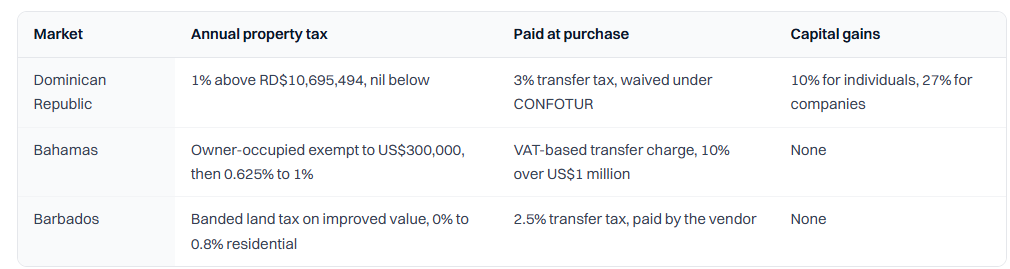
The Bahamian bands and transfer charge are set out in this guide to Bahamas property taxes, and the Barbadian land tax and the absence of capital gains tax in this summary of Barbados property tax.
Two differences matter for a second home in the US$200,000 to US$600,000 band. The Dominican exempt amount is large relative to local prices, so a mid-market apartment in Las Terrenas often owes nothing annually where a comparable Bahamian or Barbadian unit owes something every year. Against that, the Dominican Republic takes 3% from the buyer at closing in full, unless the unit is CONFOTUR certified, in which case it takes nothing.
Frequently Asked Questions
Do you pay property taxes in the Dominican Republic?
Yes, but only above a threshold. Individuals pay 1% a year on the combined DGII-appraised value of their Dominican property above RD$10,695,494 for 2026. Below that line the annual bill is zero. Foreign owners pay at the same rate as Dominican nationals, with no surcharge for non-residents.
How much is property tax in the Dominican Republic?
On a US$200,000 Las Terrenas apartment, roughly US$270 a year if DGII values it at the full market figure. On a US$575,000 villa in El Portillo, roughly US$4,000. On anything appraised below the exempt amount, nothing. Those are ceilings, because DGII appraisals usually sit under market value.
How is property tax calculated in the Dominican Republic?
Add up the DGII appraised value of every property you own in the country, subtract the exempt amount of RD$10,695,494, and take 1% of what is left. The result is split into two equal installments. A company gets no exempt amount and pays 1% on the whole value.
What is the process to pay property tax in the Dominican Republic?
File the IPI declaration within the first 60 days of the year, then pay through the DGII Oficina Virtual or at a local DGII office. The first installment is due 11 March and the second 11 September. Most non-resident owners delegate the filing to their attorney or property manager and keep the receipts on file for the eventual sale.
Are there any exemptions or discounts available for property tax in the Dominican Republic?
Yes, four. Property valued at or below the exempt amount pays nothing. A single home owned by someone 65 or over is excluded. Pensioners and rentistas on foreign-source income pay half. Rural land and agricultural improvements are outside the tax. Separately, CONFOTUR-certified units pay no IPI during their exemption period.
How does the property tax system in the Dominican Republic compare to other Caribbean countries?
The headline rate is in the same range as the Bahamas and Barbados, but the Dominican exempt amount is generous relative to local prices, so a mid-market apartment often owes nothing where a comparable unit elsewhere owes something annually. The differences show up at the ends of the transaction instead. The Dominican Republic charges 3% at closing, and Barbados charges no capital gains tax at all.
The Number to Check Before You Fall for the View
Dominican Republic property tax rarely decides whether a purchase makes sense. It is 1% a year above a threshold a lot of Las Terrenas apartments never reach, and the figures that genuinely move a deal sit at closing and at sale. The number worth checking on any specific property is the DGII appraisal, because it sets both the annual bill and the 3% at signing, and it is the one figure no listing shows you.
Considering a Conversation
To reach Leo and the Leo Estate Group team: contact page. We can pull the DGII appraisal on a unit before you make an offer and show you what a first full year of ownership actually looks like, including the years of any CONFOTUR exemption still left on the clock.
Phone
+1 829 707 0999
Office
Sector La Bonita, Calle Jose Antonio Martinez, beside Mosquito Boutique Hotel, Las Terrenas 32000, Samana
Hours
Monday to Sunday, 9am to 5pm
Sources
Source Used for
DGII Help Centre, exempt amount for the Real Estate Property Tax
2026 IPI exempt amount of RD$10,695,494 for individuals
DGII, Impuesto al Patrimonio Inmobiliario
IPI exemption categories: over-65 single home, foreign-source pensioners and rentistas at 50%, rural land and agricultural improvements, property exempt under special laws
Siempre al Dia, filing obligations for individuals in the Dominican Republic
IPI declaration due in the first 60 days of the year, installments on 11 March and 11 September
PwC Worldwide Tax Summaries, Dominican Republic, Other taxes
Real Property Transfer Tax at a basic rate of 3%, and the 18% ITBIS rate
Alburquerque, Legal Guide to the Dominican Republic, Tax Law
Flat 10% capital gains rate for individuals on real property under Law 30-26, 27% for legal entities, and 27% withholding on Dominican-source income paid abroad
Presidency of the Dominican Republic, DGII briefing on Law 30-26
Habitual residence exemption, six-month reinvestment window, over-65 exemption, and the mortgage tax falling to 1% in 2027 and ending in 2028
Pellerano and Herrera, CONFOTUR under Law 30-26
Law 30-26 did not amend the 3% transfer tax, and the restriction on accumulating incentives for the same activity, investment or transaction
CONFOTUR, Ministry of Tourism, Benefits
15-year exemption period running from completion of construction and equipment
El Inmobiliario, the gap Law 30-26 left in the secondary market
The implementing regulation has not defined the taxable base for the 10% rate, including the article 289 inflation adjustment
Diario Libre, Las Terrenas and the new generation of luxury property tourism
August 2026 median asking prices per square meter for Las Terrenas, Punta Bonita, El Portillo and Las Ballenas, from Ubikala data
Acento, Banco Central reference exchange rate, October 2026
Peso to dollar reference rate used for the conversions and worked examples
Expat Focus, Bahamas property taxes
Bahamian owner-occupied exemption and rate bands, and the VAT-based transfer charge
TaxAtlas, Barbados wealth and property tax
Barbadian land tax at 0% to 0.8% residential, no capital gains tax, 2.5% vendor transfer tax